Social Media Shadowban: How to Check and What to Do
Your posts go out as usual, followers see them, but reach suddenly drops several times over. The account isn't banned and there are no notifications, yet new people seem to have stopped finding it. This is usually called a shadowban. This article explains what it really is, how it shows up on different networks, how to check your account and what to do to get your reach back.
What a shadowban is and how it shows up
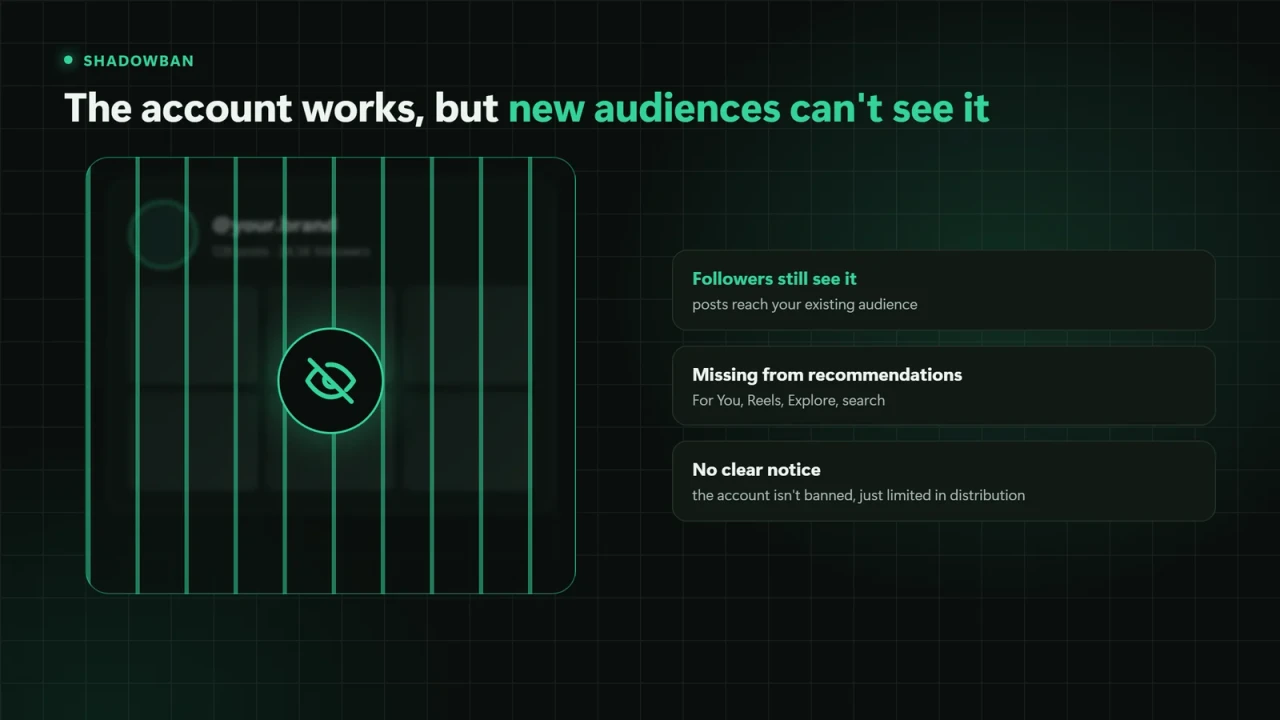
A shadowban is the informal name for a situation where a platform limits the distribution of content or an account without fully banning it. Platforms rarely use the term themselves. Official materials talk instead about content that "can't be recommended," accounts that are "ineligible for recommendation" or "limited visibility."
The account keeps working but stops appearing in recommendations and search
Typical signs of a shadowban:
reach among non-followers drops sharply while views from followers stay steady;
posts stop appearing in recommendations: TikTok's For You feed, Instagram Reels and Explore, suggested videos on YouTube;
the account or its posts don't show up in search or under hashtags;
the account's replies and comments are hidden or shown below others.
The main symptom is a drop in reach specifically among non-followers (example, sample data)
Why platforms limit distribution instead of banning
For a social network, limiting recommendations is a softer tool than a ban. It lets the platform keep content that doesn't formally break the rules but isn't suitable for wide distribution to people who don't follow the creator. Followers still see the posts; the algorithm simply stops actively suggesting them to new audiences. For the creator, a shadowban looks like a sudden loss of growth rather than a penalty. Because these restrictions are so "quiet," platforms have been adding tools that show them in account status.
Which networks it happens on most
Instagram openly acknowledges that some content and accounts can't be recommended to non-followers. Professional accounts have an Account Status section that shows whether content is eligible for recommendation in Reels, Explore and Feed. Since 2023 it also shows whether the account itself can appear in search and suggested accounts. If a post goes against the recommendation guidelines, you can find it there and appeal if you disagree.
TikTok
In May 2024, TikTok introduced a rule: if a creator repeatedly posts content that doesn't meet the For You feed standards, the whole account can become temporarily ineligible for recommendation. The platform notifies the creator and allows an appeal. You can check your standing in the Account Status section, while the Account Check tool shows the status of your last 30 posts.
YouTube
YouTube doesn't officially recognize the idea of a shadowban. Still, distribution is affected by age restrictions, limited monetization and the platform's policy of reducing recommendations of borderline content that doesn't formally break the rules but comes close. Look for signals in YouTube Studio: channel status, guideline warnings and each video's traffic sources.
X (Twitter)
X follows a "Freedom of Speech, Not Freedom of Reach" approach: posts that break certain rules may stay up but with limited visibility and a label. Users also report accounts disappearing from search suggestions and replies being collapsed in threads.
How to check whether your account is shadowbanned
Five checks that take about 15 minutes
1. Open account status in the app. On Instagram that's Account Status, on TikTok it's Account Status and Account Check, on YouTube it's YouTube Studio. It's the only official way to see restrictions.
2. Check non-follower stats. Compare the share of reach from non-followers over the last two weeks with your usual level. A sharp drop in this segment alone is the key signal.
3. Check traffic sources. If a noticeable share of views used to come from recommendations and now almost all come from your profile and followers, distribution is limited.
4. Search for the account while logged out or from another account that doesn't follow you.
5. Look for violation notices in your inbox, email and status section.
Weekly monitoring
To spot problems early, keep a simple spreadsheet and update it weekly for each account:
weekly reach and the non-follower share;
the share of views from recommendations, search and profile;
average reach per post against the three-month median;
account status: any new notices or flagged posts;
content changes that week, such as new formats, topics, tools or posting frequency.
This helps you link a restriction to a specific change, like a new auto-posting tool.
Remember that not every drop in reach is a shadowban. Reach also falls because of seasonality, algorithm updates, audience fatigue with repetitive content or stronger competition. If account status is clean and the drop is even across all sources, the cause is most likely your content or external factors.
Shadowban or natural decline: how to tell
| Sign | Likely a shadowban | Likely a natural decline |
|---|---|---|
| Account status | restrictions or flagged posts | no violations |
| How reach falls | sharply, within 1-3 days | gradually, over weeks |
| Who stopped seeing posts | mostly non-followers | followers and non-followers |
| Search and hashtags | account or posts not found | found as usual |
| Follower engagement | almost unchanged | dropped along with reach |
If most signs point to a natural decline, revisit your formats, the first seconds of your videos, your topics and posting frequency, and study what works for competitors in your niche.
What actions can lead to a shadowban
Borderline content that doesn't break the rules outright but fails the recommendation standards (for example, misleading, shocking or explicit material).
Unoriginal content: reposted videos, videos with other platforms' watermarks, repetitive posts.
Spammy behavior: mass following and unfollowing, repetitive comments, too many links.
Fake engagement: bought followers and likes, engagement pods.
Third-party automation tools that don't use an official API.
Hashtag abuse: dozens of irrelevant or banned tags under every post.
User reports, if there are many and moderation confirms them.
A hacked account: if it was used to send spam, the platform may limit its distribution.
How to recover your reach
A step-by-step recovery plan; timelines are approximate
Step 1. Diagnosis
Run all the checks above and record your baseline: non-follower reach, traffic sources and the date the drop began. This shows whether the next steps are working.
Step 2. Content review
If account status lists specific posts, remove them or appeal if you believe the decision is wrong. Review recent posts for reused material, watermarks and sensitive topics.
Step 3. Pause automation
Turn off third-party auto-posting, auto-reply and bulk-action tools that don't use an official API. Revoke access for suspicious apps in your security settings and change your password.
Step 4. Quality content at your usual pace
Don't delete the account or mass-delete old posts; it doesn't speed up recovery. Publish original content at your normal rhythm, use 3-5 relevant hashtags and reply to comments personally.
Step 5. Monitoring and appeal
Compare non-follower reach week over week. Platforms don't publish exact timelines, but changes usually become visible within a few weeks. If a restriction appears in account status and you think it's a mistake, appeal through the official form.
Sometimes the problem is easier and faster to solve not by restoring an old account, but by starting a new one. If you need ready-made accounts for a new project, you can find them at zfxshop.biz.
How to prevent a shadowban
Eight rules that protect your account from restrictions
Learn the community guidelines and each platform's recommendation standards, which are stricter than the basic rules.
Publish only original content and upload videos without other networks' watermarks.
Grow organically, without fake engagement, bought followers or engagement pods.
Use 3-5 relevant hashtags instead of long lists.
Keep a natural pace: no mass follows, likes or repetitive comments.
Connect only trusted tools that use official APIs.
Check account status weekly along with your non-follower reach.
Protect the account with two-factor authentication so it can't be hijacked for spam.
If a team or contractor runs the account, put these rules into a short policy: which tools may be connected, who checks status weekly and what to do if reach drops sharply.
FAQ
How long does a shadowban last?
Platforms don't publish timelines. Post-level restrictions lift after the post is removed or a successful appeal. Account-level restrictions, such as on TikTok, are temporary, but their length depends on your violation history.
Will deleting and reposting help?
If a post fails the recommendation standards, uploading the same content again won't fix it and may make things worse. Rework the material or publish something new that fully complies.
Can I contact support?
Yes. If a restriction appears in account status, use the appeal button next to it. If status is clean, support usually can't "lift" a restriction that doesn't exist, so look for the cause in your content and stats instead.
Does paid promotion bring reach back?
Ads buy impressions but don't lift restrictions on organic recommendations, and content that breaks the rules won't pass ad review. Fix the cause first, then add promotion.
Do shadowbans affect business accounts?
Yes, account type doesn't protect against restrictions. But business and creator accounts have more diagnostic tools: detailed insights, traffic sources and a status section that shows recommendation restrictions.
Conclusion
A shadowban isn't a mystery or a penalty without a reason. It's a recommendation restriction, usually tied to content or account behavior. Instagram and TikTok already show these restrictions in account status, and for YouTube and X, stats and traffic sources are your guide. If reach drops, start with diagnosis, remove the likely cause, return to regular quality content and track the trend. The best protection is following platform rules and growing organically.