TikTok vs Instagram: Which Is Easier to Grow On?
TikTok vs Instagram: Which Is Easier to Grow On?
Say you're launching a creator account, a brand or an online store. Should you start on TikTok or Instagram, and where will results come faster? We didn't want to rely on opinions, so we pulled together open data: Socialinsider's benchmarks across 70 million posts, Rival IQ's industry report, DataReportal's audience statistics and the platforms' own explanations of how their algorithms work. Then we compared TikTok and Instagram across 8 criteria and 6 regions of the world.
The short answer
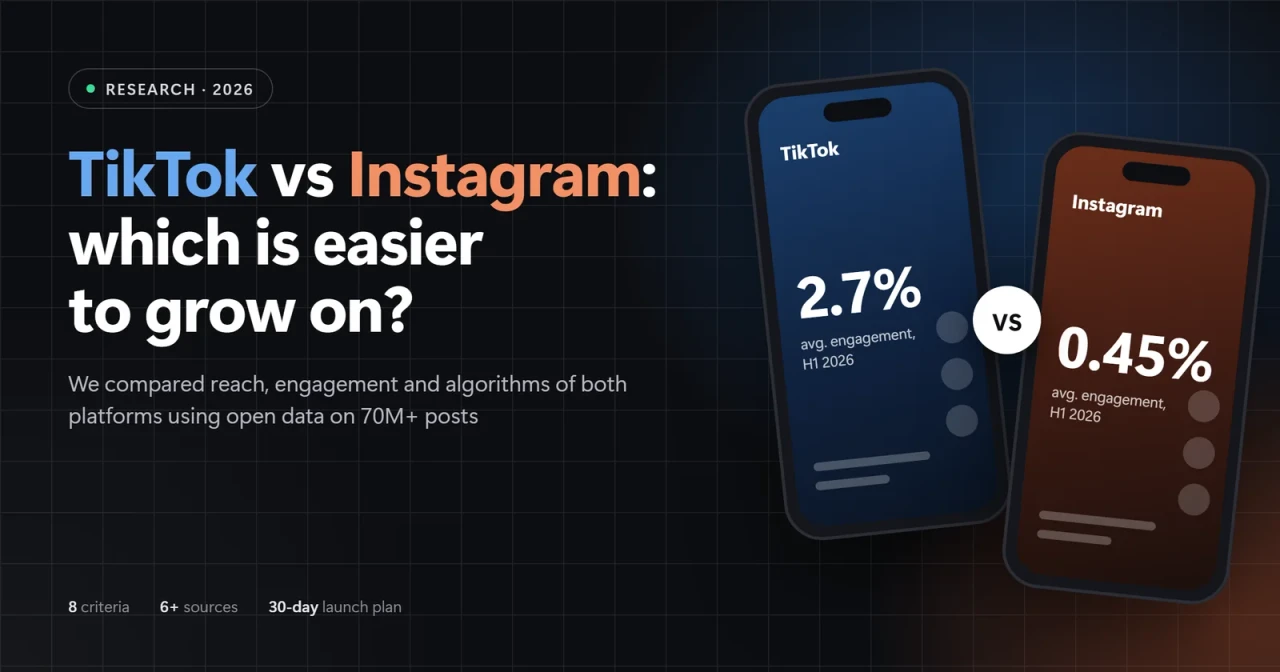
TikTok is the easier place to start from zero. Its average engagement rate is 6–7× higher than Instagram's (2.7% vs. 0.45% in H1 2026), and TikTok says follower count is not a direct factor in its recommendations. Instagram wins when it's time to sell: it has 3 billion monthly users, plus Stories, DMs and a profile that works like a storefront. The biggest caveat is your market: TikTok is banned in India, while Indonesia is its largest audience in the world.
Methodology: what this study is based on
We combined independent analytics reports with official platform sources from 2025–2026.
| Source | What we used | Sample and period |
|---|---|---|
| Socialinsider, 2026 Social Media Benchmarks | Engagement, views, shares, posting frequency | 70M brand posts, 2024 to H1 2026 |
| Socialinsider, Instagram Reels Statistics 2026 | Reels reach by account size and video length | 140,000 Reels from business accounts, Jan–Jun 2026 |
| Rival IQ (Quid), 2026 Social Media Industry Benchmark Report | Median engagement, posting frequency, industries | 150 random companies per industry (from a database of 200,000+) |
| DataReportal / Kepios, Digital 2026 | Audience size, time spent, country data | Platforms' advertising tools |
| TikTok Newsroom, Meta, Instagram | How recommendations work, official figures | — |
Limitations:
The Socialinsider and Rival IQ benchmarks cover brand accounts. Personal creator accounts may perform differently.
Engagement rate (ER) is calculated per follower. For TikTok this understates performance, because TikTok views depend only loosely on follower count.
All figures are averages or medians. Your niche may differ, so treat them as benchmarks rather than guarantees.
TikTok vs Instagram by the numbers (2026)
Audience: Instagram is bigger, TikTok holds attention longer
Instagram has 3 billion monthly active users, according to Meta (September 2025). It's the third Meta app to reach that milestone, after Facebook and WhatsApp.
TikTok ads reach 1.59 billion adults, or 27.5% of everyone aged 18 and over (DataReportal). Ad reach isn't the same as total users, but it's the most comparable metric available.
Time spent on Android averages 1 h 37 min a day on TikTok and 1 h 13 min on Instagram (DataReportal, Digital 2026).
What this means for newcomers: Instagram reaches more people, but each TikTok user spends more time in the app. That leaves the platform more impressions to hand out, including to videos from new creators.
Engagement: TikTok leads by 6–7×
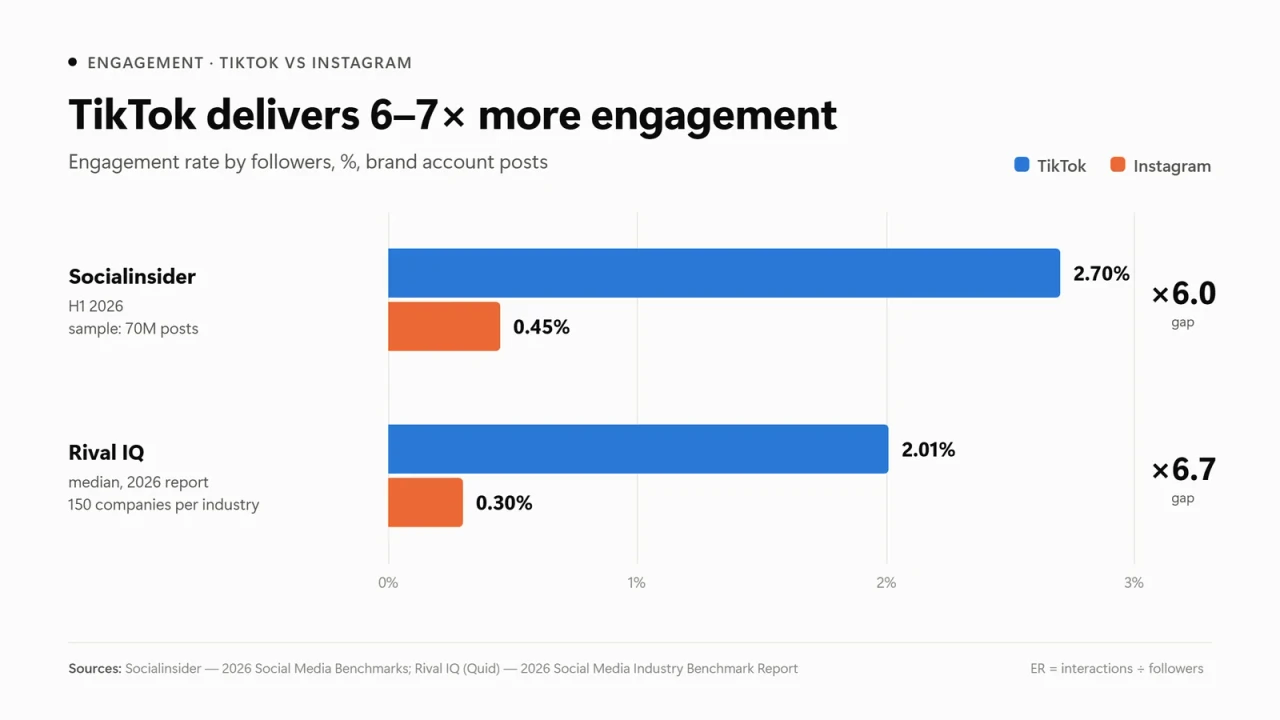
Two independent studies show the same gap: 6–7× in TikTok's favor. Sources: Socialinsider, Rival IQ
Two independent sources reach almost identical conclusions:
Socialinsider (H1 2026): TikTok ER is 2.70% and Instagram's is 0.45%, a 6× gap.
Rival IQ (median, 2026 report): 2.01% vs. 0.30%, a 6.7× gap.
Engagement is falling on both platforms. Socialinsider shows TikTok's ER dropping from 3.73% in 2025 to 2.6–2.7% in 2026, and Rival IQ's median for Instagram fell from 0.36% to 0.30%, down 17% year over year. Easy wins on TikTok are getting rarer, but the gap between the two platforms is still several-fold.
Rival IQ also found that brands post almost twice as often on Instagram (a median of 3.7 posts a week vs. 2 TikTok videos), yet get less engagement there. To get the same response on Instagram, you'll need to create more content.
By industry, pharma, higher education, alcohol and energy brands performed best on TikTok. Beauty and retail had the lowest engagement on every platform, because both niches are saturated.
Views and shares: TikTok leads, Instagram is closing the gap
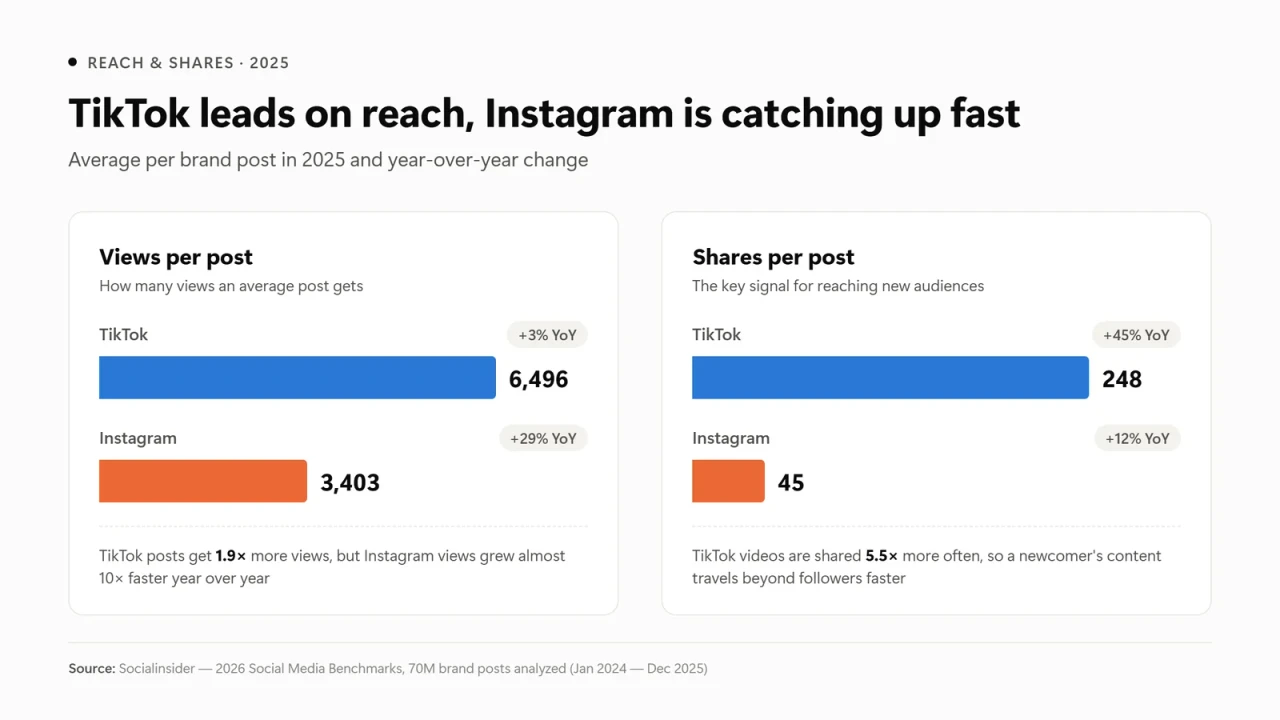
TikTok wins on absolute numbers, but Instagram views grew 29% in a year. Source: Socialinsider
Average brand post in 2025, per Socialinsider:
| Metric | TikTok | |
|---|---|---|
| Views per post | 6,496 (+3% YoY) | 3,403 (+29% YoY) |
| Shares per post | 248 (+45% YoY) | 45 (+12% YoY) |
| Comments per post | 50 (−24% YoY) | 20 (−16% YoY) |
Takeaways:
1. The average TikTok post gets 1.9× more views and is shared 5.5× more often. Shares are the main way a video reaches people beyond the creator's own followers.
2. Instagram views are growing almost 10× faster than TikTok's. Instagram's bet on Reels is working, and the gap is narrowing.
3. Comments are declining on both platforms. People watch and share more than they write, so judge your videos by watch-through and shares, not likes.
Why it's easier to start from zero on TikTok: how the algorithm works
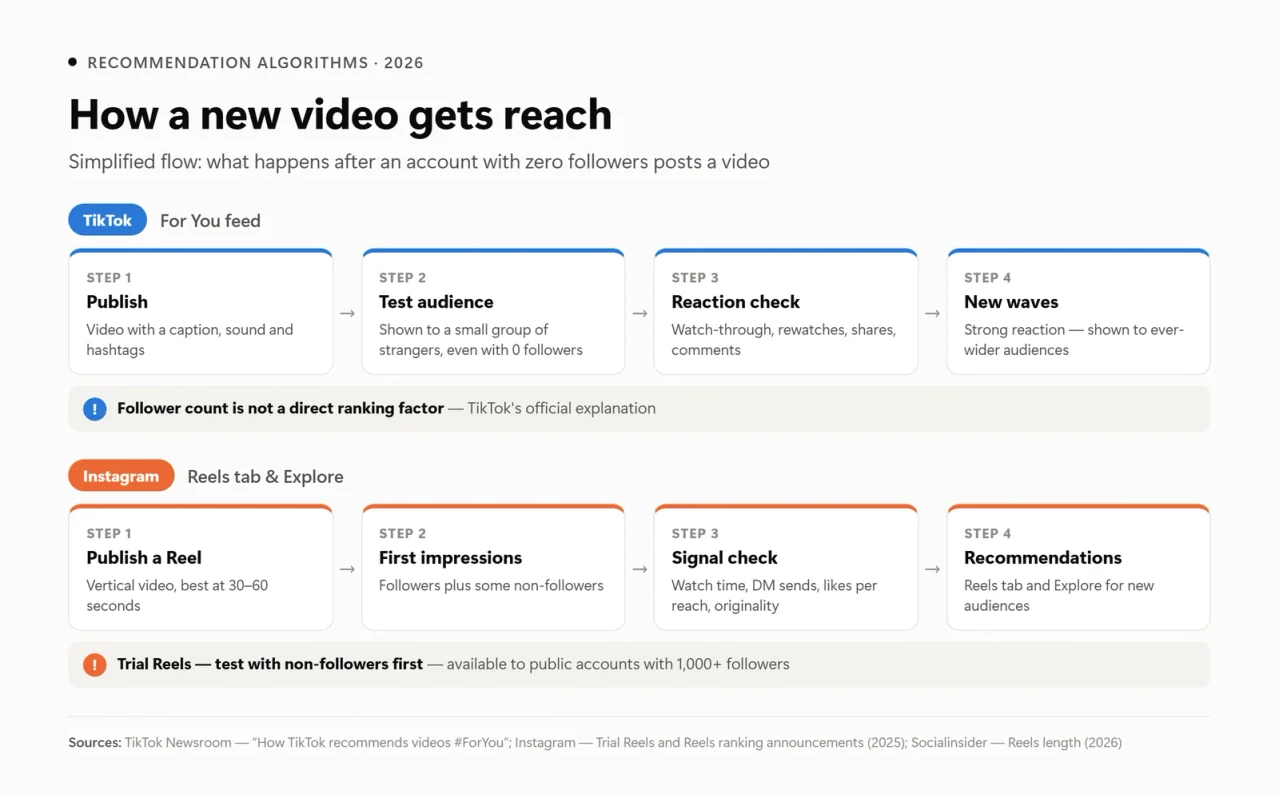
How a video from an account with zero followers gets reach on TikTok and Instagram
TikTok's biggest advantage for newcomers comes straight from the platform. In its official explanation of the For You feed, TikTok says that neither follower count nor whether an account has had previous high-performing videos is a direct factor in recommendations. TikTok also notes that bigger accounts still tend to get more views, simply because more people follow them.
In practice, it works like this:
1. Publish. The algorithm reads the video's caption, sound and hashtags.
2. Test audience. The video appears in the feeds of a small group of strangers, even if the creator has zero followers.
3. Reaction check. Strong signals outweigh weak ones. For example, finishing a longer video matters more than the viewer and creator being in the same country. Rewatches, shares and comments count too.
4. New waves. If the reaction is strong, the video is shown to progressively wider audiences.
Every video is judged on its own merits, so a brand-new account competes for impressions on nearly equal terms with big creators. Equal doesn't mean easy, though: you still have to hold attention from the very first second, just like the top creators do.
Instagram in 2026: what are a newcomer's chances?
Instagram is no longer a platform where only accounts with a big following get reach. It has steadily pushed Reels and smaller creators.
Reels give small accounts more reach
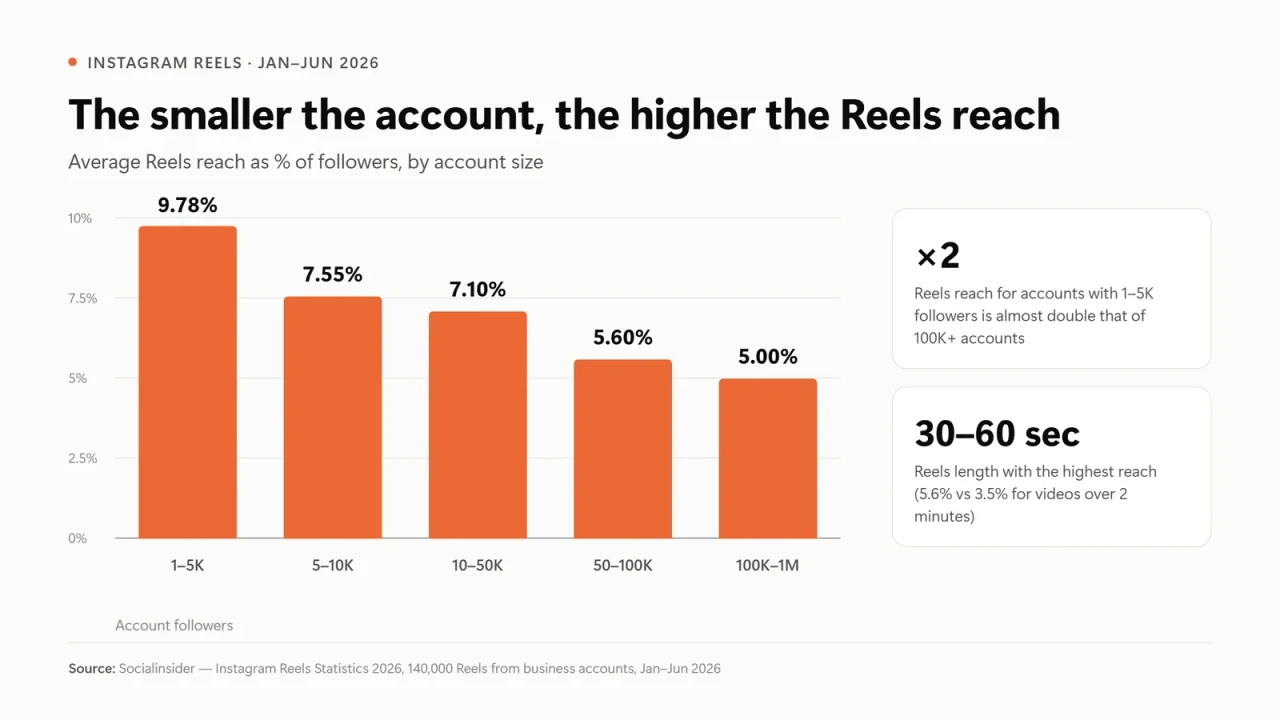
Accounts with 1–5K followers get almost double the Reels reach of accounts with 100K+. Source: Socialinsider
Socialinsider's data on 140,000 Reels from January–June 2026 shows:
Accounts with 1–5K followers get a Reels reach of 9.78% of their followers. For accounts with 100K–1M, it's 5%.
Reels are the highest-reach format only for accounts under 50K followers. Above that, carousels take the lead.
The best-performing length is 30–60 seconds (5.6% reach), compared with 5.2% for videos under 30 seconds and 3.5% for videos over 2 minutes.
Keep in mind that reach here is measured as a percentage of followers. Instagram does show Reels to non-followers, but an account with no audience has a harder time generating those first signals. That's why starting from absolute zero is usually slower on Instagram than on TikTok.
What Instagram ranks: watch time, sends and originality
The three key signals. Instagram head Adam Mosseri has named watch time, likes per reach and sends per reach as the most important ranking signals. A DM send is the strongest signal for showing a Reel to non-followers.
Originality. Instagram reduces the reach of reposted content and aggregator accounts. Reels with another platform's watermark, such as a TikTok logo, also get fewer impressions.
Trial Reels. A Trial Reel is shown only to non-followers first and doesn't affect the creator's main feed. Since 2025 the feature has been available to public accounts with 1,000+ followers, so brand-new accounts can't use it yet.
A shift to "real" content. In his 2025 year-end post, Mosseri said the polished aesthetic is fading, and that raw, authentic content is becoming more valuable as AI-generated content floods feeds. That's good news for newcomers: you don't need an expensive production setup.
TikTok vs Instagram by market
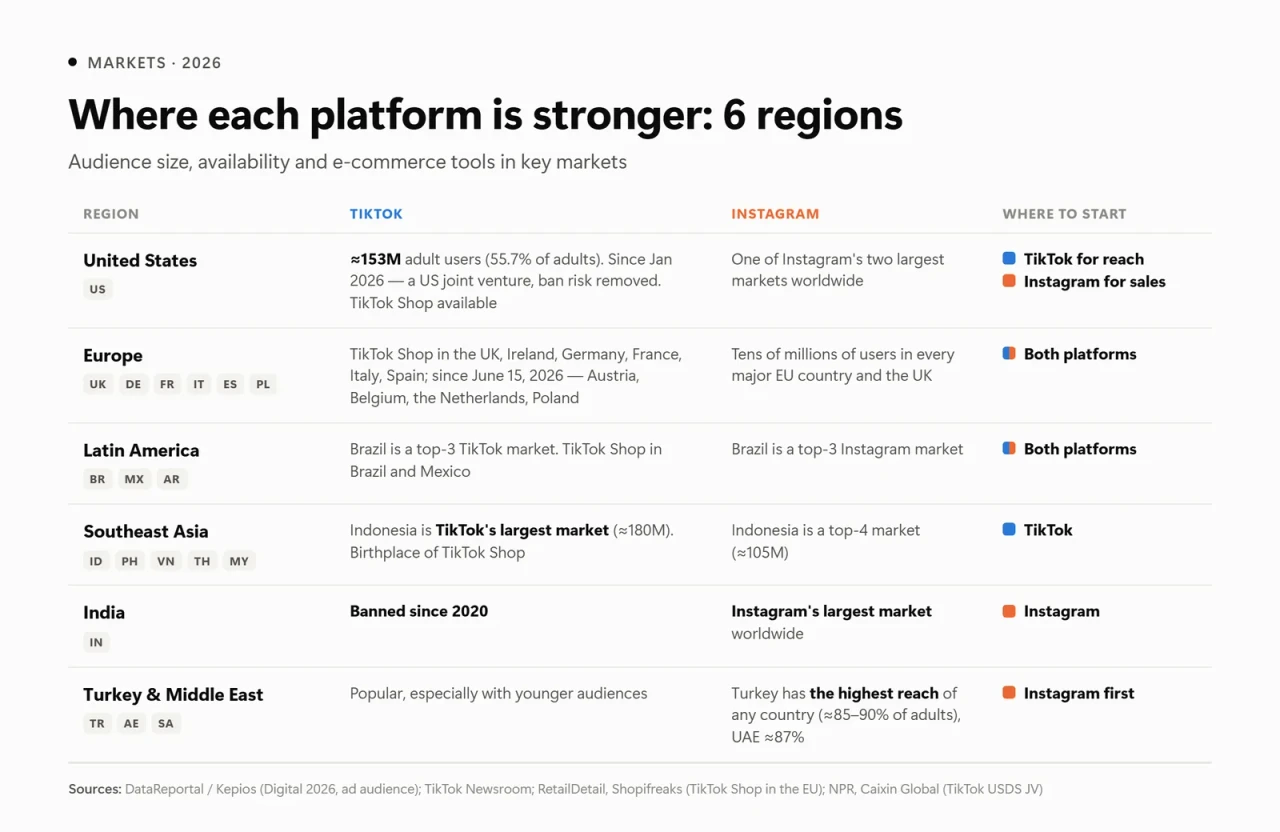
Each region has its own leader, and in some countries the choice is obvious
There's no universal answer: it depends on where your audience lives.
United States
TikTok has about 153 million adult users, or 55.7% of US adults (DataReportal, late 2025). The question of a ban is settled: on January 23, 2026, the deal creating TikTok USDS Joint Venture closed. ByteDance kept 19.9%, while Oracle, Silver Lake and MGX each hold 15% as managing investors. US user data is stored in Oracle's cloud. For creators nothing changed: it's the same app, and TikTok Shop is live. The US is also one of Instagram's two largest markets.
Strategy: TikTok for reach, Instagram for nurturing and sales.
Europe
TikTok Shop is live in the UK, Ireland, Germany, France, Italy and Spain, and on June 15, 2026 it expanded to Austria, Belgium, the Netherlands and Poland. Instagram has tens of millions of users in every major EU country and the UK. One regulatory nuance: under the EU's Digital Services Act, users can switch off the personalized feed.
Strategy: use both platforms. For e-commerce, TikTok Shop is a new growth channel.
Latin America
Brazil is a top-3 market for both TikTok and Instagram, and Mexico is a major market for both as well. TikTok Shop operates in Brazil and Mexico.
Strategy: use both. If you sell products, start with TikTok.
Southeast Asia
Indonesia is TikTok's largest market in the world (about 180 million, DataReportal) and the birthplace of TikTok Shop. Social commerce is deeply rooted across the region, including Indonesia, the Philippines, Vietnam, Thailand and Malaysia. Instagram has about 105 million users in Indonesia.
Strategy: prioritize TikTok.
India
TikTok has been banned in India since 2020. India is also Instagram's largest market in the world, and Reels is the dominant short-video format there.
Strategy: Instagram, no question.
Turkey and the Middle East
Instagram ads in Turkey have the highest reach of any country, around 85–90% of adults. In the UAE it's about 87%. TikTok is popular in the region too, especially with younger audiences.
Strategy: start with Instagram and use TikTok as a second channel.
The scorecard: TikTok vs Instagram across 8 criteria
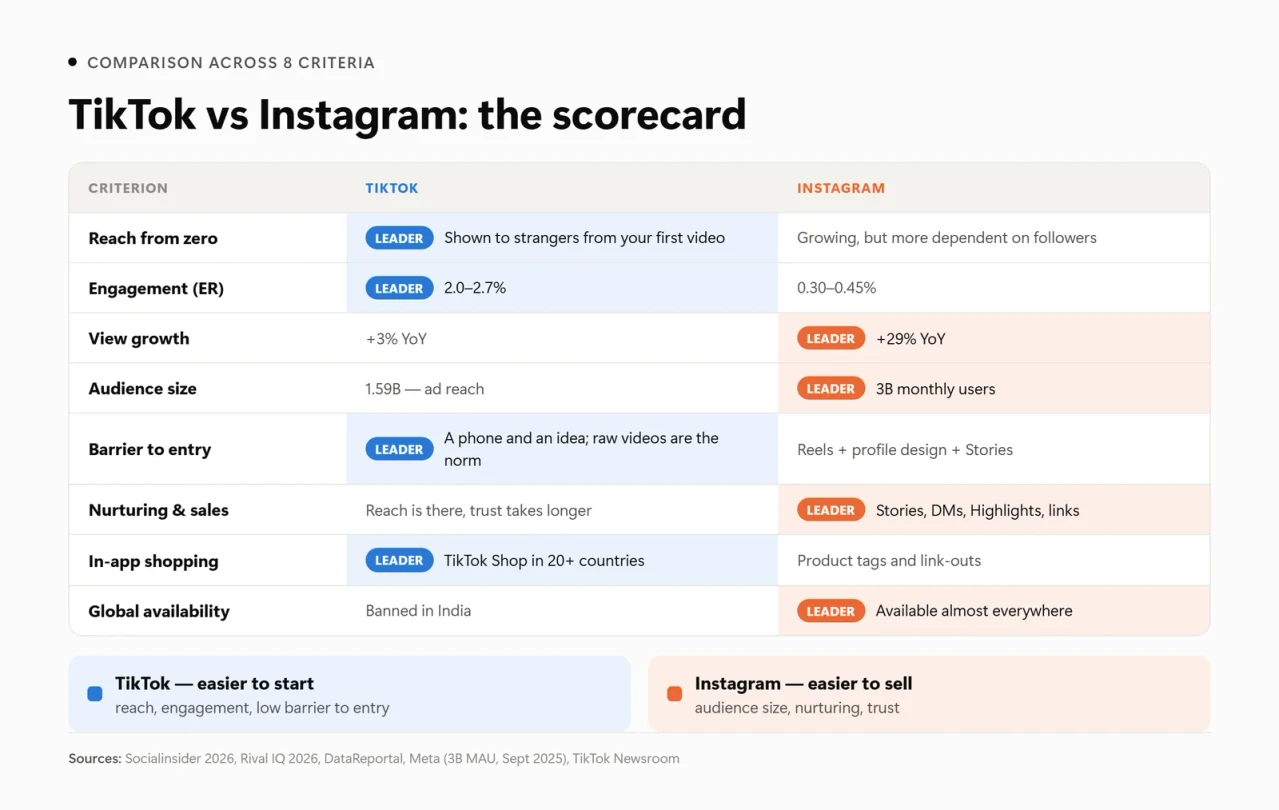
It's 4–4: TikTok is easier to start on, Instagram is easier to sell on
| Criterion | TikTok | Leader | |
|---|---|---|---|
| Reach from zero | Shown to strangers from your first video | Growing, but more dependent on followers | TikTok |
| Engagement (ER) | 2.0–2.7% | 0.30–0.45% | TikTok |
| View growth | +3% YoY | +29% YoY | |
| Audience size | 1.59B (ad reach) | 3B monthly users | |
| Barrier to entry | A phone and an idea; raw videos are the norm | Reels + profile design + Stories | TikTok |
| Nurturing & sales | Reach is there, trust takes longer | Stories, DMs, Highlights, links | |
| In-app shopping | TikTok Shop in 20+ countries | Product tags and link-outs | TikTok |
| Global availability | Banned in India | Available almost everywhere |
Which platform should you choose? A checklist
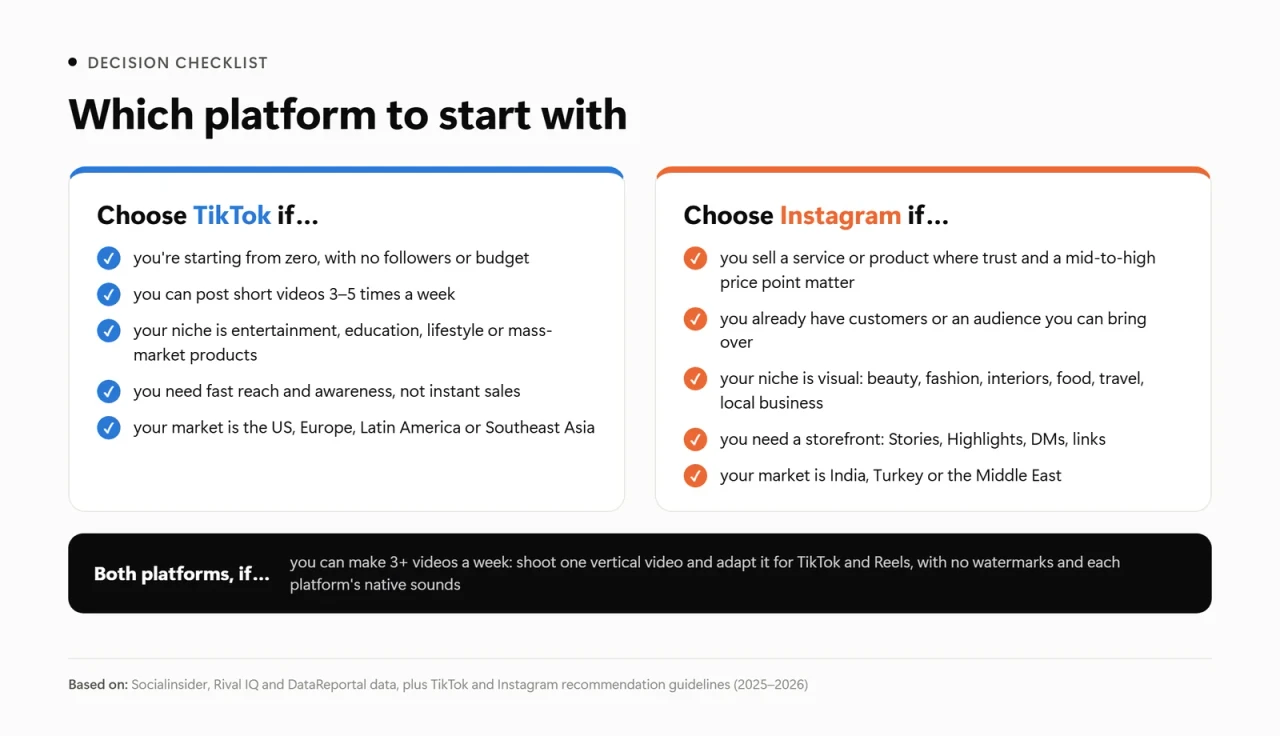
Five signs for each platform
Choose TikTok if:
you're starting from zero, with no followers and no ad budget;
you can post short videos 3–5 times a week;
your niche is entertainment, education, lifestyle or mass-market products;
you need reach and awareness more than instant sales;
your market is the US, Europe, Latin America or Southeast Asia.
Choose Instagram if:
you sell a service or product where trust matters and the price point is mid-to-high;
you already have customers or an audience you can bring to your profile;
your niche is visual: beauty, fashion, interiors, food, travel or local business;
you need a storefront for your brand: Stories, Highlights, DMs, links;
your market is India, Turkey or the Middle East.
Use both platforms if you can produce 3+ videos a week. Shoot one vertical video and adapt it for each platform: remove watermarks and add sound inside each app.
| Project type | Where to start | Why |
|---|---|---|
| Expert or creator with no audience | TikTok | Reach doesn't depend on followers |
| Online store, mass-market products | TikTok (+ TikTok Shop where available) | High reach and in-app shopping |
| Services, high price point, local business | Trust, DMs, Stories, testimonials in Highlights | |
| Brand with an existing audience | Instagram + TikTok | Instagram retains your audience, TikTok brings new people |
30-day launch plan
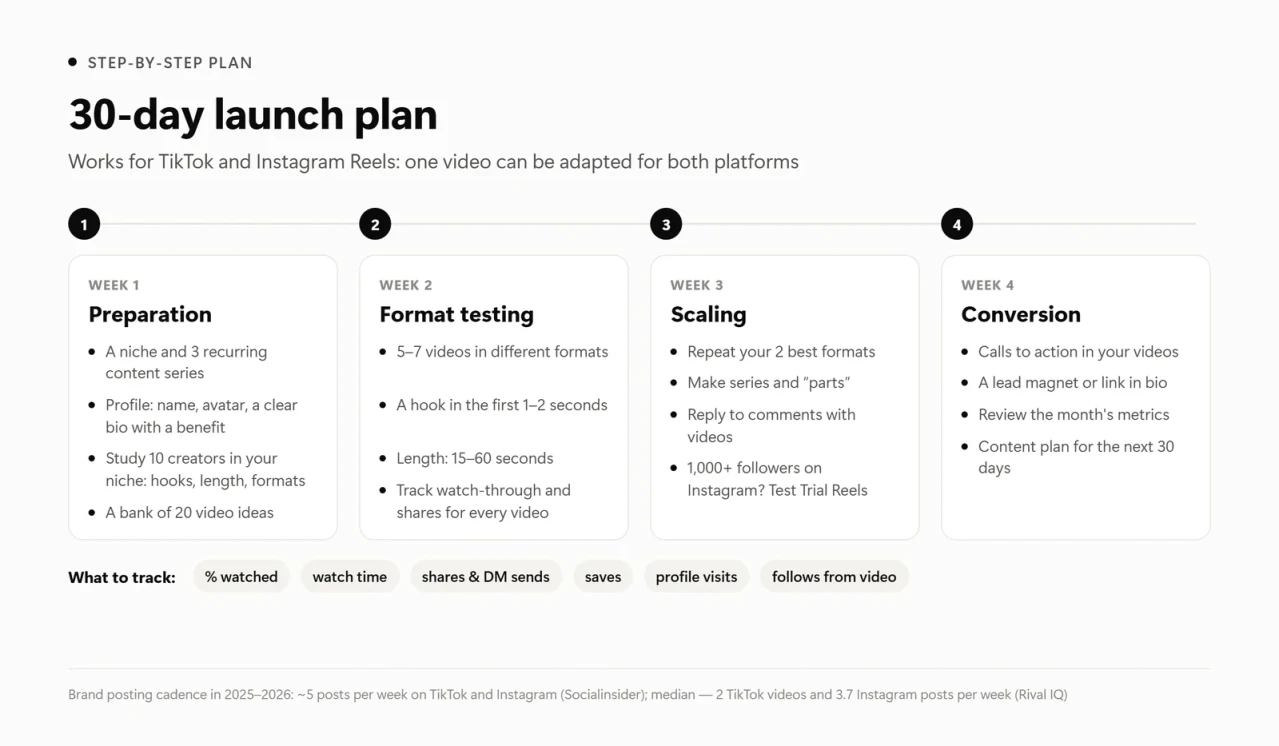
Four weeks from preparation to your first leads
Week 1. Preparation
Pick a niche and 3 recurring content series, such as "mistakes," "before/after" and "breakdowns."
Set up your profile: a clear name, an avatar and a bio that spells out the benefit for viewers.
Study 10 creators in your niche: their hooks, video length and formats.
Build a bank of 20 video ideas.
Week 2. Format testing
Publish 5–7 videos in different formats.
Hook viewers in the first 1–2 seconds with a question, a result or a conflict.
Keep videos 15–60 seconds long. On Instagram, Socialinsider found the best reach for Reels of 30–60 seconds.
Track watch-through rate and shares for every video.
Week 3. Scaling
Repeat your 2 best-performing formats.
Launch series ("Part 1," "Part 2"); they bring viewers back.
Reply to comments with videos.
Once you have 1,000+ Instagram followers, test new ideas with Trial Reels.
Week 4. Conversion
Add calls to action to your videos.
Create a lead magnet or put a link in your bio.
Review the month's metrics.
Plan content for the next 30 days.
What to track: % watched, watch time, shares and DM sends, saves, profile visits, follows from each video.
7 mistakes that slow down growth
1. Posting videos with another platform's watermark. Instagram shows this content less. Upload the original file without logos.
2. Opening with a long intro. Both TikTok and Instagram weigh retention most heavily. If nothing happens in the first few seconds, the video loses impressions.
3. Drawing conclusions after 2–3 videos. The algorithm judges every video separately. You need at least 10–15 posts before drawing conclusions.
4. Chasing likes. Socialinsider's data shows comments falling and shares rising. Shares and watch-through matter more for reach.
5. Buying followers. Bought followers don't watch or react. That drags down your ER and the signals the platform uses to decide whether to push your content further.
6. Cross-posting without adapting. Each platform has its own trends, sounds and style. One source video is fine; an identical video everywhere is not.
7. Ignoring your market. If your audience is in India, TikTok isn't an option. If it's in Indonesia, skipping TikTok means missing the platform's largest audience in the world.
FAQ
Where is it faster to get your first followers: TikTok or Instagram?
TikTok. Its recommendations show videos to strangers regardless of follower count, and its average engagement rate is 6–7× higher than Instagram's (Socialinsider, Rival IQ).
Which is better for business, TikTok or Instagram?
TikTok is better for awareness and mass-market product sales, especially in countries where TikTok Shop is available. Instagram is better for services, higher price points and local businesses: Stories, DMs and Highlights help build trust and guide customers to a purchase.
Can I post the same video on TikTok and Instagram?
Yes, as long as you remove watermarks and adapt the video: add sound inside each app and change the on-screen text and cover. Instagram reduces reach for unoriginal content and for videos with other platforms' logos.
How many videos should I post per week?
Brands average about 5 posts a week on each platform (Socialinsider). The median is 2 videos a week on TikTok and 3.7 posts on Instagram (Rival IQ). As a newcomer, aim for 3–5 videos a week and keep that pace.
How long should my videos be?
On Instagram, Reels of 30–60 seconds get the highest reach, while videos over 2 minutes get noticeably less (Socialinsider, 2026). On TikTok, focus on retention: a video should be exactly as long as your story can hold attention. For a start, 15–60 seconds works well.
Is TikTok available in the US in 2026?
Yes. On January 23, 2026, the deal creating TikTok USDS Joint Venture closed: US investors hold a controlling stake, and US user data is stored in Oracle's cloud. The app works as before.
Conclusion
TikTok vs Instagram? Based on 2026 data, TikTok is the easier place to start growing. Engagement is 6–7× higher, posts are shared 5.5× more often, and the algorithm doesn't need followers to show your video to a new audience. Instagram is slower at the start, but it has twice the audience, faster view growth (+29% a year) and better tools for turning viewers into customers.
For most projects, the best strategy is to build your audience on TikTok and sell through Instagram, using the same source videos for both. Always check which platform leads in your market: in India the answer is clearly Instagram, and in Southeast Asia it's TikTok.