


Trusted vs New Ad Accounts: Which to Use for Ads in 2026
Trusted vs New Accounts: Which to Choose for Advertising and Affiliate Traffic
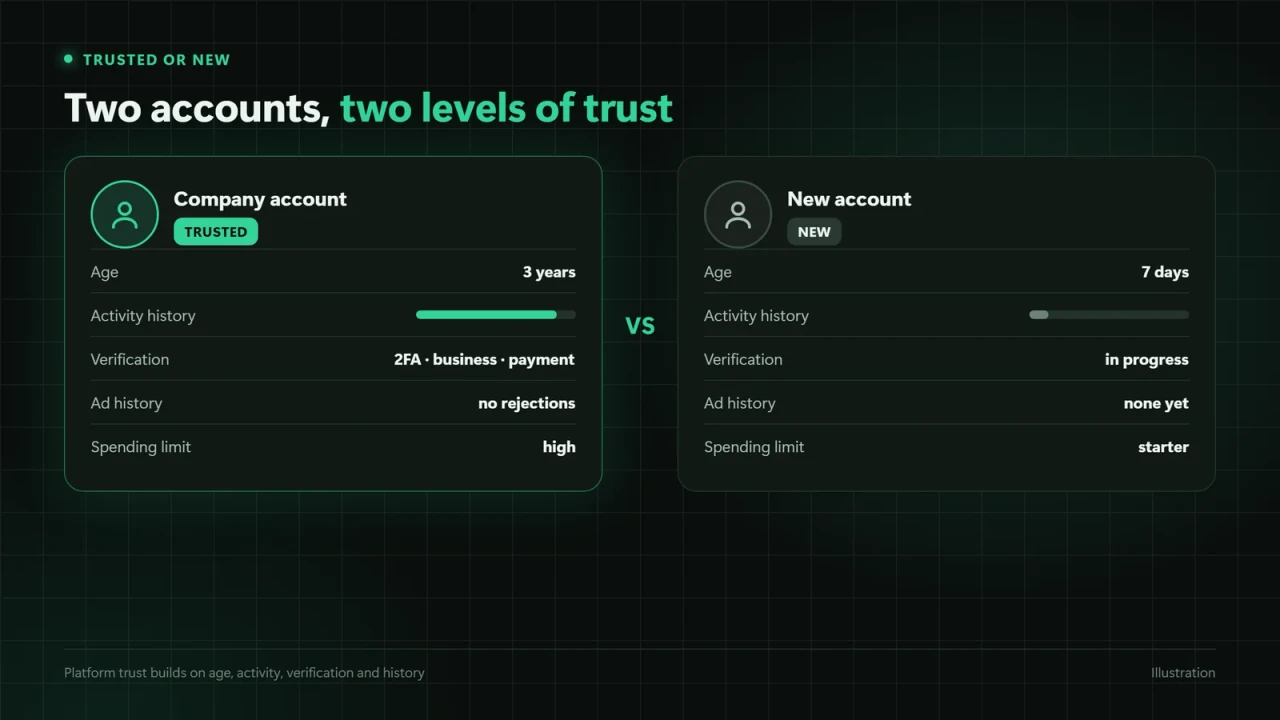
When it's time to launch ads, marketers often compare "trusted" and "new" accounts. The choice affects spending limits, ad review speed and how quickly you can scale campaigns. Let's look at what account trust really means, which factors shape it, and when it pays to use an established account versus starting fresh.
If you need ready-made trusted accounts for advertising or affiliate marketing, you can find them at zfxshop.biz. It's handy when you need to start fast without a long warm-up.
What a trusted account is and how it differs from a new one
A trusted account is a profile or ad account that a platform trusts because of its history. It has existed for a long time, is used regularly, is verified by its owner and has no serious violations. A new account is a freshly created profile or ad account with no history yet. The platform doesn't know how it will behave, so it applies starter limits and closer checks.
Trusted and new accounts differ in age, history, verification and limits
"Trust" isn't an official term or a setting. No platform publishes a trust formula. It's a shorthand for the set of signals that security and review systems use to assess an account. So it's more accurate to talk about how much trust your own account has built up than about "trusted" and "untrusted" accounts as different products.
Profile trust and ad account trust are not the same
There are two levels. The first is trust in a personal or business profile: how long it has existed, how it's used and whether the owner is verified. The second is trust in the ad account: its history of ads, reviews and payments. They're related but not identical. A profile with years of history can own a brand-new ad account with starter limits, while a young company with a clean payment record can quickly reach high ad limits. Look at both levels when assessing an account.
What factors affect account trust
Account age
Age is the most obvious factor. An account that's several years old has passed many checks and built a history. But age alone guarantees nothing: if a profile sat unused for years and then suddenly started running large ad budgets, the platform is more likely to see a reason for an extra check than a sign of reliability.
Trust grows gradually when an account is used continuously without violations
Activity and history
Platforms assess account behavior over time: regular posts, real replies to messages, steady use of the ad account. Even, predictable activity earns more trust than sudden spikes, such as dozens of actions in an hour after months of silence.
Regular activity and a clean history are the basis of platform trust
Verification and linked assets
The more closely an account is tied to a real owner, the more it's trusted. This includes:
a verified email and phone number;
two-factor authentication;
business verification in the business account (for example, Meta's business portfolio);
a verified domain for the website your ads point to;
a payment method in the name of the account owner or company.
Ad and payment history
For ad accounts, rejected ads, user complaints and payment problems matter most. An account whose ads mostly pass review the first time and whose payments go through without declines gradually earns higher limits. Meta, for example, applies a daily spending limit that often affects new business and ad accounts. Practitioners frequently report it at around $50 a day, rising over time while the account stays in good standing.
Policy compliance
Warnings, restrictions and rejected ads lower trust. The best way to build it is to learn the platform's advertising policies before launching campaigns and not to risk your history for a single questionable ad.
When a new account is better and when a trusted one wins
When to choose a new account
A new business or brand. A newly registered company needs its own ad account in its name.
Project separation. A separate ad account for a new project inside your business portfolio gives you clean analytics and an independent budget.
Client work. An agency should create an ad account in the client's business account and get partner access, rather than run the client's ads from its own.
Testing a new niche. A new account lets you test a direction without mixing its stats with your main data.
When a trusted account pays off
Scaling. If a campaign already works and you need to raise the budget fast, an established account with high limits saves time.
Sensitive categories. Finance, health, education and similar areas often require extra verification and certification, which is easier for a long-running business.
Long-running campaigns. For always-on brand advertising, stability matters more than launch speed.
How trusted accounts help in advertising and affiliate marketing
Affiliate marketing, or media buying, means buying ads and monetizing the traffic, most often through affiliate programs that pay per action. Here, trust in the ad account directly affects the economics.
The more trusted the account, the smoother ad review and budget scaling
Predictable review. Ads from an account with a good history are more likely to pass without delays, so tests launch on time.
Budget flexibility. High limits let you quickly shift money to a winning campaign setup.
Stability. Fewer sudden pauses and checks mean fewer lost days and broken stats.
Agency ad accounts. Many affiliate teams work through agency ad accounts from official platform partners. These usually offer higher limits, post-payment and access to support.
Trust isn't a way around ad review. Ads in any account are checked against the same policies, so creatives, landing pages and offers must comply.
What to check when choosing an account
Each option has its strengths: the choice depends on your goal
1. Ownership. The account and ad account are registered to you or your company. Most platforms require the account to belong to the person using it, so trust can't be "transferred" from someone else's profile.
2. Account status. No active restrictions, warnings or unresolved checks (on Meta, see Account Quality).
3. Verification. Two-factor authentication is on, and the business and domain are verified.
4. Payment method. The card or billing account belongs to the ad account owner, with no declined payments.
5. Limits. The current daily spending limit matches your planned budget.
6. Review history. The share of rejected ads and the reasons.
7. Linked assets. The Page, Instagram account, pixel, catalog and domain are connected and working.
8. Access. Roles are given only to people who work with the account, and the owner has a backup admin.
How to build trust in your own account
If you have a new account, you can build its trust systematically:
complete the profile and verify your business and domain;
start with small budgets and raise them gradually, by 20-30% per step;
run proven creatives that clearly comply with policies;
keep regular organic activity on the Page or profile;
make sure payments go through without declines;
fix rejected ads quickly and appeal when needed.
Take care of the team, too. If several people work in the account, give each their own role and appoint at least two admins on the business owner's side. You won't lose access if someone leaves, and actions stay transparent. Check account status regularly: warnings handled promptly barely affect trust, while unresolved issues can lead to restrictions at the worst moment, such as right before a seasonal campaign.
Example: launching ads for a new project
Imagine a company launching a new cosmetics brand and deciding where to run its ads. A step-by-step scenario could look like this:
1. Structure. A company launching a new cosmetics brand creates a separate ad account inside its existing business portfolio. It keeps the link to the verified company, and the brand's stats stay separate.
2. Assets. The brand gets its own Page and professional Instagram account, the website domain is verified and a pixel is installed.
3. First two weeks. Two or three campaigns run with small daily budgets and creatives that clearly meet cosmetics advertising rules.
4. Growth. If ads pass review without rejections and payments go through, the budget rises by 20-30% every few days.
5. Scaling. After one or two months, the account has its own history, and its limits support full budgets.
This combines the best of both options: a new account gives clean analytics, while a verified company and a careful start build trust quickly.
Common misconceptions about trusted accounts
"Older means more reliable."
Age matters only alongside continuous history. A profile that sat idle for five years looks almost new to the system, and a sudden ad launch from it may trigger extra checks.
"Trust protects you from ad review."
No. Every ad is checked against the same policies. A good history can make review faster and more predictable, but it won't approve a non-compliant ad, and serious violations lower trust even for long-running accounts.
"Trust can be moved to another project."
Trust is tied to a specific account and its owner. Also, an ad account created inside a Meta business portfolio can't be moved to another portfolio, so plan your account structure in advance.
"A new account is always a bad start."
New accounts start with starter limits, but for testing ideas or a new brand that's fine. Small starting budgets make sense anyway, and careful work in the first weeks builds history fast.
FAQ
How long does it take for an account to become trusted?
Platforms don't give timelines. In practice, noticeably higher limits and stable reviews appear after several weeks or months of regular work without rejected ads or payment issues.
Why is a new ad account's limit so low?
Starter limits protect both the platform and the advertiser from errors and fraud. As the account spends and pays on time, the limit rises gradually.
Can I run several projects from one account?
You can, but it complicates analytics and raises the cost of a mistake: one project's problems affect the whole account. For different brands or clients, separate accounts inside one business portfolio work better.
What if an established account gets restricted?
Open the account status section, find the cause and fix it: edit or remove the ad, or verify your identity or business. If you believe the decision is wrong, request a review through the official form.
Where can I get trusted accounts for advertising?
Ready-made accounts with history for advertising can be found at zfxshop.biz. It's handy when you need to start quickly without spending weeks warming up a new ad account.
Conclusion
A trusted account pays off when you need high limits, stable reviews and fast scaling. A new account is better for clean analytics, separate projects or a new business. Either way, trust is built the same way: the account is yours, verified, used regularly and run according to platform rules. That's what gives advertising and affiliate marketing what they need most: predictability.